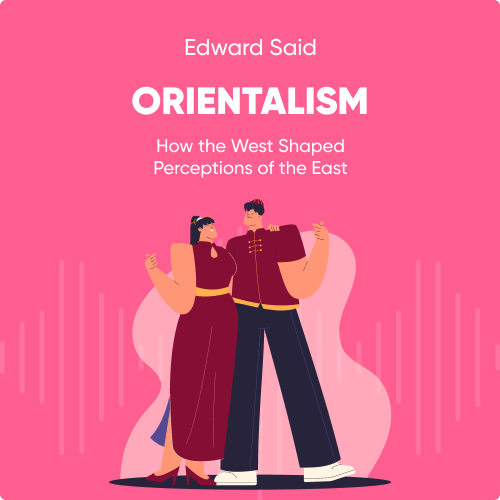
Orientalism

The story of how knowledge became power in colonial narratives.

Edward Said

What is this book about?

  • Cultural Criticism
  • Decision Making
  • Postcolonial Studies
Edward W. Said’s Orientalism is a groundbreaking critique of how Western scholarship and culture have historically portrayed the East. Published in 1978, this influential work argues that Western depictions of the “Orient”, encompassing the Middle East, Asia, and North Africa, are not objective truths but constructed narratives that serve colonial and imperial interests. Said explores how literature, academia, and art have perpetuated stereotypes, framing Eastern societies as exotic, backward, and in need of Western intervention. By dissecting these representations, Orientalism reveals the deep-seated biases that continue to influence perceptions and policies today. It invites readers to question the power dynamics embedded in cultural narratives and to seek a more nuanced understanding of global relations.

Listen to the first chapter

00:00

KEY INSIGHTS

Ready, Set, Listen!

01
Knowing the Oriental
02
Imaginative Geography and Its Representations: Orientalizing the Oriental
03
Projects and Institutions
04
Moments of Crises
05
Redrawn Frontiers, Redefined Issues, Secularized Religion
06
Silvestre de Sacy and Ernest Renan: Rational Anthropology and Philological Laboratory
07
Oriental Residence and Scholarship: The Requirements of Lexicography and Imagination
08
Pilgrims and Pilgrimages, British and French
09
Latent and Manifest Orientalism
10
Style, Expertise, Vision: Orientalism's Worldliness
11
Modern Anglo-French Orientalism in Fullest Flower
12
The Latest Phase

Recommended for you

The Culture Map

Salt Fat Acid Heat

Outliers

Salt